Current-year internet fandom culture where I'm from leans heavily on the "MatPat-brained" analytical style of hyperliteral detail-databasing, ignoring more 'artistic' (affective, experiential, thematic, etc) meanings, instead taking everything as riddles which must be "solved" to work out in-universe information.
An art object works in interaction with a viewer/player to produce an experience. In stories, this experience structures the art as an apparatus which accesses a little fictional world with characters and events and whatnot. Whereas most analytic methods are concerned more generally with this experience/interaction, the MatPat-brained method immerses itself within the apparatus, taking the fictional world very literally as a real objective thing ("the canon") and scrutinizing it as such. The art object is reduced to a representation of this canon, and the analytic work to be done is in deciphering ("solving") the representation, to get a clearer view of the canon. This is a normal mode of engagement when experiencing a story, and a normal mode of analysis for mystery stories in particular, but to be MatPat-brained is to generalize it as the dominant mode of analysis, disregarding (or co-opting) other modes, even or especially concerning works which are obviously not mysteries in any usual sense (eg Mario games). MatPat-brained analysis may or may not care about authorial intent; the point is just that the analysis is diegetic, its concerns immersed within the fiction, taking the experience of a work only as means of accessing in-universe information rather than as an object of interest in itself.
I am not here to tell you that "theorycrafting" is bad (my website is full of it) or that it's good (you can probably gather that "MatPat-brained" has a negative connotation) or whatever. I am admittedly very MatPat-brained myself, but I am also somewhat disturbed by how this mode of analysis has dominated other modes online, despite their interests being practically orthogonal.
It's easy to see how the riddle-solving proclivity might obscure one's view of the actual appeal of the work one is obsessing over. The emotional experience or messaging of the work is abstracted away... Or, if it is considered, it is considered insofar as it is useful to the theorycrafter as a meta consideration to guide theories (co-opting, ie "Your theory can't be right, because it doesn't fit the themes!"). Everything is ultimately wrapped around into in-universe interpretation, "solving" what happens within the story, which is intrinsically valued as the ultimate goal of analysis. The meaning of a work is not "what it means to me", but rather, "what fictional events take place."
So, while MatPat-brained analysis proliferates online, simultaneously proliferating is a backlash against it, and against popular series which seem to feed into it. At the cultural center of all this is Five Nights at Freddy's.
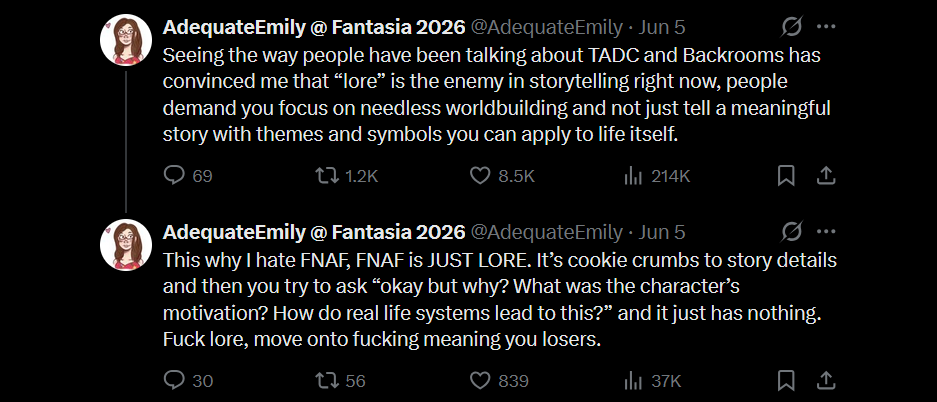
Nowadays FNaF is known as the contrived and narratively hollow lore series, a mess of retcons generating endless new uncertainties to fuel the autopoiesis of youtube theoryslop. Since Security Breach, I don't think this is really an unreasonable view, though it's a shame how it's colored the cultural perception of even the early games. 1-3 have a straightforward and more-or-less clearly communicated central story arc: Man kills kids and stuffs bodies, kids' souls haunt animatronics. It's a basic ghost story to justify the animatronics being spooky. 2 builds up the killer with more victims, then 3 reveals his ironic fate as the spirits get their revenge. The secret minigames make us empathize with the children's suffering, and then resolve with their souls finally passing on, wrapping up the story in a tidy way.
What's most compelling about this story is not its literal narrative content, but rather the integration of that content into the experience of the games. These aren't story-driven adventure games with sprawling worlds full of characters and dialogue and whatnot... they're small point-and-click games where you sit in one room and do the same thing over and over for 7ish minutes at a time. How do you tell a story with that?
Every night, there's a man on the phone giving you advice. Slipped into his ramblings are the occasional little hints, giving some character and form to the setting. The gameplay centers around observing animatronics, and there's clearly something weird about their behavior. Something paranormal. Hallucinations flash onscreen. Objects on cameras randomly change. Rarely, you'll catch a glimpse of a newspaper clipping, describing a tragedy from long ago. You've just died, and suddenly you're playing an arcade game. At least, it's an arcade game at first, but there's a detail out of place, and things quickly devolve into some abstract depiction of a disturbing event, before cutting back to normal gameplay. You catch a brief glimpse of a character you've never seen before, and then they're gone. Who was that? What's their story? You won't be told. Study the sporadic clues you've been given, and construct an answer yourself.
FNaF is all about exploring these sorts of creative storytelling methods. We piece together the narrative by scraps collected from newspapers, camera footage, employee training tapes, and most notably, haunted arcade games. Even when we technically know all the notable plot points, there's still a sense of obscurity or indirectness in its portrayal which lends itself to mystery and horror, the minimalism and abstraction creating a sense of distance from the events being depicted, like you'll never quite see the full picture. We know the missing children from the very beginning, but it takes six games before we learn their names. We don't play the story; the story is always on the periphery of what we see directly, conveyed through breaks and gasps which randomly cut into the experience as if by mistake, framing the gameplay scenarios as consequences of some long-past tragedies nearly forgotten to time, but whose cries can still be heard if only one listens closely.
There's my broad-strokes non-MatPat-brained analysis of FNaF's storytelling. Scott Cawthon found a novel way to embed a ghost story with "ghost story vibes" into video game mechanics (exactly how novel I'm not qualified to say). The analytic play of lore and theory is the experience this storytelling mode cultivates; arguably, it is the experience of Five Nights at Freddy's. It's easy to see how that becomes tangled in MatPatian pedantry.
Mysteries in stories are typically setups for some later payoff, a 'big reveal' which lays out explicitly the solution to the riddle for the viewer's satisfaction. Horror stories often subvert setup-payoff structures, leaving things intentionally unresolved to force the viewer to dwell in a discomforted state. These concepts are synthesized in, for example, an ambiguous ending, where a story leaves questions intentionally unanswered to maintain that unsettled uncertainty. FNaF has some traditional reveals, but just as often it plays on this "horror-mystery" effect of ambiguity, but with the promise that there are answers to be found in the games, if only one can interpret the esoteric clues seeded throughout. The payoffs are technically still there, but as something to be constructed by the analyst using the tools provided.
At its best, this gives the feeling of digging into some old conspiracy, finding interesting ways to piece together those little scraps into something coherent, and even when failing to bring everything into full focus, being motivated nonetheless by the knowledge that there is an answer, that things do fit together somehow, if only you can figure it out. The story develops, familiar elements reappear, motifs are established, and thus the series builds up a network of detail-relations whose topology shapes a rich interpretive landscape one can easily become immersed in.
At its worst, on the other hand... Well, as more time passes, the series drags on, complexity compounds with no end in sight, meanwhile release frequency dies down, and old debates settle into stable states (either local consensus or endless loops). The construction of new payoffs (theorizing) becomes increasingly convoluted, as the body of interconnected clues which must be held under consideration grows larger and larger, while still refusing to crystalize into a clear narrative. The structure that now emerges, the setup which just keeps on setting up, but which can never really be paid off, may be familiar to you: It is the structure of capitalist consumption.
To quote Brooks, from the Quarantine Collective, describing the Marvel Cinematic Universe:
"There's a weird thing with these films. There's an obsessive interconnection between them: There's post-credit scenes, there's a requirement to watch everything, even TV shows and side things and web series, to understand all of it. There's an infinite deferral of resolution in all of it, even today.
[...] It performs the structure of capitalist consumption. That's it. It's not a metaphor- literally that. Every film is kind of a partial object that promises completion through consuming the next object, despite the very literal awareness everyone has that at no point is the story actually over. Even the one they're about to see. It can't end. The structure produces desire for totality, that can't be achieved, because new products are eternally added.
[...] The MCU is no longer entertainment, but is actually a really good diagram of how late capitalism structures subjectivity through consumption."
I suspect the dominance of MatPat-brained analysis online can be at least partly attributed to the dominance of this structure. The discomforting distance between player and story produced by the minimalism I described earlier is the gap between the subject and the object of desire- the objet petit a, which can be used to drag players along endlessly to the next product. "Solutions" to mysteries are continually destabilized by new releases. Fill our insatiable gullets! More shitty Scholastic books! Maybe this one will finally solve the lore! (It won't.)
In light of this, it's both funny and interesting to note that almost all the original games were made with the intent of being the finale. (Yes, even Sister Location.) This forced all the mysteries to (at least attempt to) play fair, as in, be solvable in principle with the tools already provided. The answer cannot be "just wait for the next thing" if there is no next thing. The objet a structure was always there- MatPat himself called it out back in 2015. It's not a particularly exceptional structure. But the endless deferral which defines capitalist consumption only entered in gradually as the series expanded and expanded and refused to stop expanding even though it ended a decade ago, and those decade-old mysteries are still the ones people really seem to care about. The modern games have this persistent feeling of buildup, for me, building up more and more random unsolvable mysteries and... Well surely this will all pay off in the next release, right? ...Right? And you can only keep caring about those same old ambiguities for so long before burning out, or more commonly, just losing interest.
Anyway. I'm not here to whine about modern FNaF. There's some good stuff. But my fixation has primarily been reserved for the original games. One of them in particular, actually, the one which happens to be at the heart of all this. Let's talk about that one. As though I haven't talked about it enough.
The surface story of Five Nights at Freddy's 4 was told more directly than anything before, but attempting to place it in continuity with the overarching story immediately caused lots of headaches. I mean, I personally had a headache lasting several days following its release. The game kind of wrecked the 2015 theorycrafting community, and still to this day, when FNaF theories get really contrived, it's often some old detail from 4 causing mischief. Though he'd later come to see it as "too broad for interpretation", Scott Cawthon originally saw its unresolved mystery as "a fitting conclusion", and was for a while committed to leaving the series there. It was not designed as a setup to drag us along forever, despite the direction things may have gone afterwards. FNaF4 was the ending, in a more serious way than any of the others.
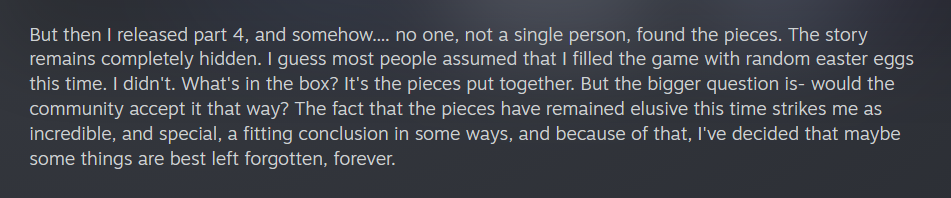
The really egregious popular misinterpretation of this quote bothers me a lot, because Scott's actual point here resonates with me in a way most either seem blind to or uninterested in. I don't need to persuade anyone, but I would like to at least be understood.
In my view, the "haunting the narrative" trope popular in fandom spaces is a pretty literal articulation of what FNaF4 is going for, but where "haunting" is the particular kind of haunting produced by FNaF's unique storytelling structure: the haunting of the obscure, the ungraspable, the forgotten traumas so deeply essential yet so faintly perceptible.
Scott was in a weird place with 4, needing to come up with some fitting conclusion after 3 had already wrapped up the story. Fredbear's may have lost its mystique nowadays, but at the time it had been built up as this obscure location lost to time, the enigmatic origin of Golden Freddy. It made sense to take the final game back to the beginning for a full reveal of Fredbear's, and the obvious narrative move was to give the mysterious original location a mysterious original victim. It's easy to read the bite as this original trauma which is repressed, festering in the unconscious of the narrative, and whose resolution marks the end of the story (Happiest Day). It isn't exactly an accident that the kid's fate is left perpetually unclear, that he's only rarely and indirectly referenced outside FNaF4, and that we still don't know his name. It's kind of the whole point. The crying child is positioned as the heart of the series' mystery, as its central lack. For FNaF's storytelling structure, haunting the narrative means haunting the experience of the narrative, the experience of constructing its ambiguities into payoffs. The crying child haunts the interpretation of the narrative. The crying child haunts the fandom.
The long awaited payoff to FNaF4's mystery is probably not coming just around the corner. It's been eleven years. For better and for worse, the lack of payoff is the point.
But the bigger question is- would the community accept it that way?