In Scott's first interview with Dawko, despite lore questions being disallowed, one exception was made: Which FNaF3 ending happens? Though he ultimately decided not to give a straight answer, he still addressed the question in the interview, to announce to the fandom that the answer is "very interesting" and "complex".
MoltenMCI clearly problematizes FNaF3's good ending. If the children haunt Molten Freddy, how does Happiest Day fit in? Does it just not happen? Is it pushed back, after FFPS?
Well, I doubt that Happiest Day would simply not happen. FNaF3 is Scott's favorite, and Happiest Day is its most iconic scene, arguably an important part of the series' identity, being referenced over and over by the games after 3. For it to simply not happen would be a very strange narrative decision, disappointing in a very obvious way. It is hard for me to believe that Scott would simply decanonize it.
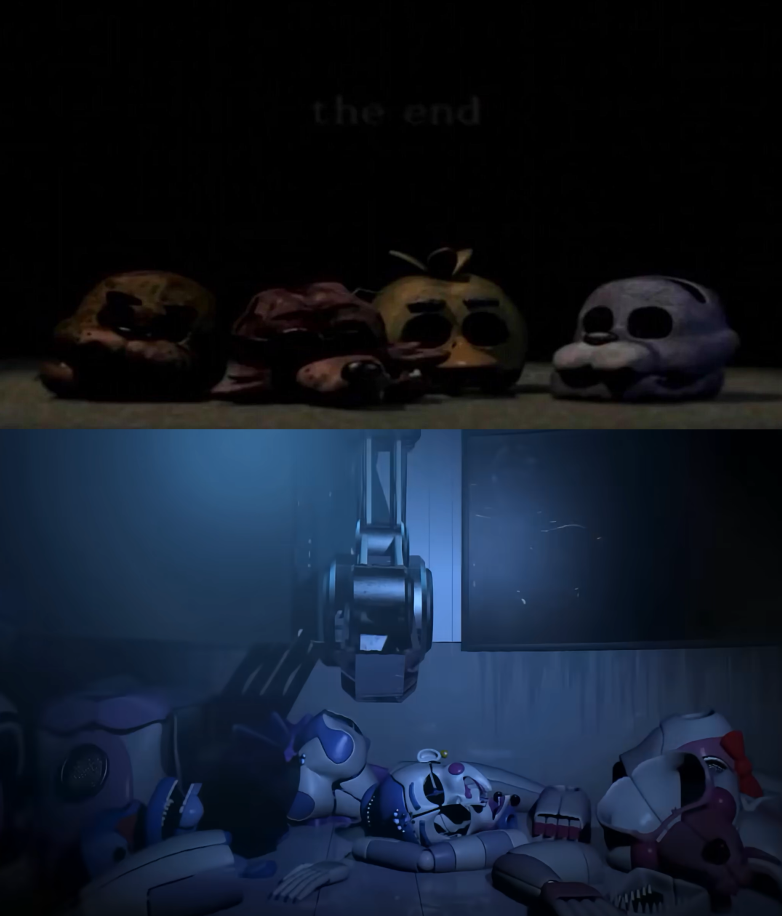
Secondly, I think that Happiest Day is kind of inseparably tied to Fazbear's Fright. The good and bad endings use the empty heads of the Classics to represent the spirits, in visual parallel with the suits hanging around the building with lights in their eyes. There is an implied connection between 3's minigames and the physical arcade machines at the attraction. The player accesses these minigames via objects lying around the building. I don't really think the FNaF3 minigames are things which can be cleanly separated from the context of game itself, to be slid freely along the timeline wherever one pleases. They can only really happen at Fazbear's Fright.
But even beyond these critiques, it is hard for me to overlook the fact that neither popular explanation really takes Scott's description seriously. The bad ending being the canon one and Happiest Day being pushed forward are very simple and, in my opinion, boring expanations. In fact, they are practically the simplest answers conceivable! A better answer is needed, a more "complex" and "interesting" answer, to address the central contradiction of Happiest Day and MoltenMCI: If the children were put to rest at Fazbear's Fright in FNaF3, how can they live on in Molten Freddy?
Here is my answer.
In Follow Me, the endoskeletons are taken away by William, and the spirits along with them, to be injected in the Funtimes. Yet on night 5, there they are, still at Freddy's, to William's surprise. They haunt the Funtimes in SL, and become Ennard; Yet, they also appear at Fazbear's Fright, accessed through the arcades. It's almost as if they're in two places at once...
Well, that is what I think is the case.
When Afton dismantles the animatronics to take the endoskeletonss, he leaves the suits lying on the ground at Freddy's. In splitting apart the suits and endos, he is also splitting the spirits. There is thus, in effect, two copies of the children's souls, which go down two diverging narrative paths. The endos are melted and injected in the Funtimes; the suits are brought to Fazbear's Fright and hung as decorations.
(If you think the children's souls being split between multiple places is an absurd unprecedented concept, then you really need to read The Fourth Closet. And maybe the Frights epilogues, for good measure.)
Notice how FNaF3 gives special significance to the empty suits: We see them splayed on the ground in Follow Me between nights, we see them prominently displayed in the attraction, and we see their hollow heads in the endings, the lights in their empty eye sockets used to represent the spirits' fates. SL, on the other hand, gives focus to the internal endoskeletons- The plot revolves around the scooper, which is, besides a melted metal injector, a tool for scooping endos out of suits, allowing the Funtimes to abandon their shells and take on the pure naked endoskeleton form of Ennard. To represent the spirits, FNaF3 makes symbolic use of the empty eye sockets. SL instead uses the eyeballs underneath, whose colors represent Elizabeth and the MCI's presence, displayed prominently on Ennard.
The narrative move being made is to allow both FNaF3 endings to effectively happen, in this branching way. The FNaF3 spirits are brought together in Happiest Day, with Charlie (Henry's daughter), for the good ending. The SL spirits are brought together in Ennard, with Elizabeth (Afton's daughter), for the bad ending.
This theory is sometimes called SplitMCI, and I am quite confident that it was Scott's intention with SL. But despite everything, there is one big problem, which you may have noticed.
The Charlie Problem
Happiest Day does not just free the missing children. It also frees Charlie. Yet, she reappears in FFPS all the same, in Lefty. This might seem like a fatal blow, but considering the strong theoretical and narrative backbone of everything thus far, I am more interested in looking for explanations within SplitMCI than in throwing the whole thing out and starting over. It is hard to deny that the children are split, when we see them at Freddy's in Follow Me, and access their spirits in Fazbear's Frights. Yet without Happiest Day, the narrative backbone justifying this split is lost, leaving only meaningless contrivance.
So. How can Charlie's presence in FFPS be explained? I see two major possibilities.
1) Retcon
Though it is unsatisfying, Charlie could simply have been retconned out of Happiest Day.
FFPS already makes at least one explicit retcon regarding the Puppet, for the purposes of bringing the novels' characters into the games for its own plot. This would be a part of that- Puppet is important to the story FFPS tells, so Scott would simply have retconned her into the game. Like Charlie's gender, this retcon would be clearly established, and perhaps directly addressed with Henry's:
"My daughter, if you can hear me, I knew you would return as well. It's in your nature to protect the innocent."
I will note that Frights gives an explicit precedent for Charlie sticking around after she 'should have' rested. There is also the interpretation (which I find absurd, but many disagree) that sees her slow-falling mask as symbolic of her lingering a while after the minigame.
The problem is obvious. Happiest Day ends with all the children disappearing, their masks falling, and 6 balloons floating away. Regardless of interpretation, later games recontextualize Happiest Day in a way which at least borders on being a retcon, but having the minigame happen without Charlie would be a blatant contradiction. Retconning a pronoun from a random FNaF2 minigame is one thing; retconning a main character entirely out of their most beloved scene, a scene where they play a pivotal role as the player character, is another thing entirely.
But still perhaps not implausible.
2) Maskless Lefty
In the end of FNaF2, we are told that the Toy animatronics are scrapped, the narrative function being to explain why they are not present in FNaF1. The same applies to the Puppet- Though the newspaper doesn't directly tell us she was scrapped, we were likely meant to infer it simply by her absence in FNaF1.
FNaF3 then shows clearly that, similar to the Toys, the Puppet has at some point been dismantled offscreen. We are told that Springtrap is the "only one left", and we see Puppet's mask hanging alone in the attraction.1
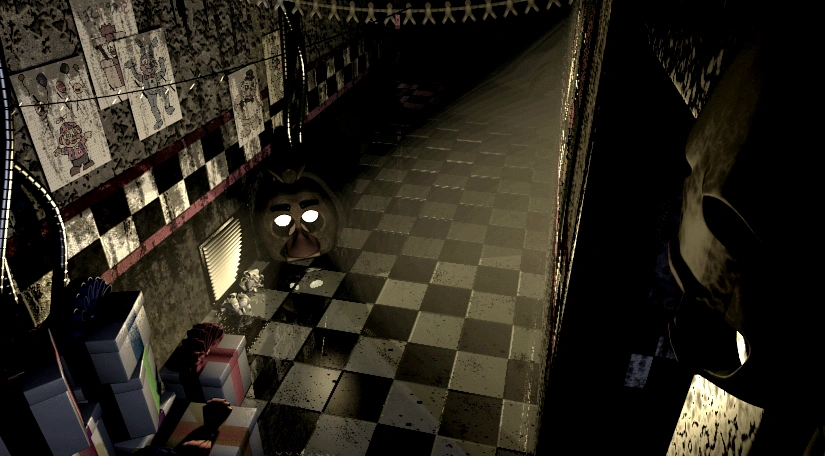
At the time of FNaF3, the Puppet's mask has been separated from its body. This is not speculation, it is what we are directly shown.
But then, Puppet reappears in FFPS, seemingly intact. But conveniently, it is concealed inside Lefty. While in 3 we only see its mask, in FFPS we only ever see a bit of its arm, visible between Lefty's arm segments.
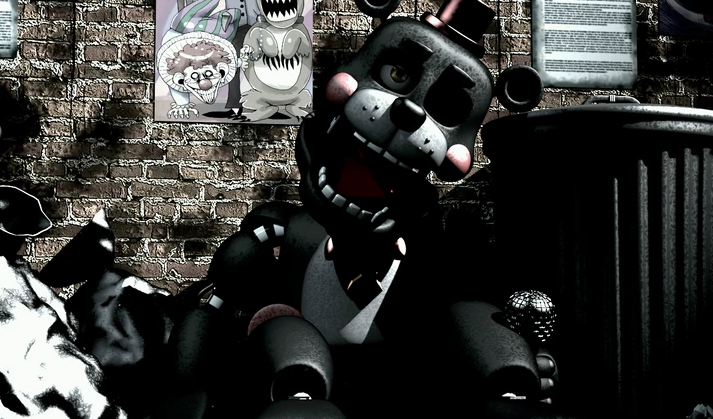
Perhaps, then, the Puppet inside Lefty is not the whole Puppet. Perhaps it is just the body, or whatever remains of the body after being dismantled, with the mask left behind. And following this line of thought, perhaps Charlie was split between those two parts, just like the MCI, so the Charlie haunting the mask could go free in Happiest Day, while the Charlie haunting the body can still return in FFPS.
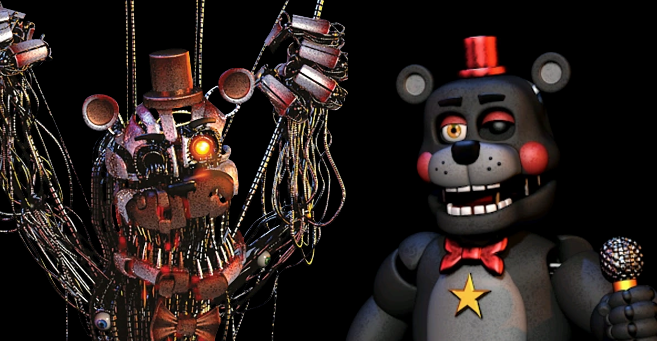
Molten Freddy has one dark eye, and one glowing eye. Since Molten Freddy is the embodiment of the bad ending, this is likely a reference to the lit eye sockets of the bad ending masks. Lefty too has one dark eye- his left eye, hence the name "Lefty". It's an interesting detail, especially for the game to call attention to. Perhaps this too is symbolic? One missing eye, symbolic of Charlie's 'missing half', the half released in Happiest Day?
This is my favorite solution to the Charlie problem. It is the best in-universe fit, I think, literally explaining all of the canon events we see. Lefty containing Puppet's mask is arguably the more presumptuous position, requiring either a retcon or offscreen retrieval. Nonetheless, it is a bit suspicious. I would like if there were something pointing to it more directly, so I know it's something Scott actually thought of, and I'm not just wandering off into fanfiction.2
~
Despite what you may assume, SL was made with the intent of being the final game.
You know, I had originally wanted FNaF 4 to be the end but wasn’t satisfied with what people took away from it. Then I planned on Sister Location being the last game but wasn’t satisfied with where it left the lore. Then I made Pizzeria Simulator, and I was happy where it left the lore but not completely satisfied with the experience overall. But after the really great reception of UCN, I think I’m finally happy. :)
- Scott Cawthon (post now deleted but archived here)
This is seemingly against the fan consensus, which sees SL as a horrible place to leave the story. What was Scott thinking?
A recurring challenge Scott faced making these games is how to build on a narrative which was already complete. FNaF3 concluded the story, giving endings to all the main characters. For FNaF4's ending, Scott went back to the beginning, to finish things off with the reveal of the original incident which sparked everything else. Now, the story has been tied up on both ends, the beginning and ending. How could it be continued?
This was the question Scott had to answer with SL, and I think this is what he came up with. FNaF3 left this loophole, with the endoskeletons vanishing in Follow Me, leaving just the shells, originally intended to set up for Springtrap to be the only animatronic left at the time of Fazbear's Fright. With those endoskeletons, the MCI could be split, thus splitting the story along these two paths, preserving FNaF3's good ending while creating new parallel narrative potential in the bad ending.
The ending people really want is what FNaF3 delivered: A clean resolution, bringing the loose threads together to tie up and give the story a sense of closure. SL is not interested in that. It leaves off on an uncertain, unsettling note. Ennard escapes, wearing Mike's skin. The children are loose, still decaying in both mind and body.
Considering FNaF is a horror story, this sort of horrifically unresolved ending could be considered fitting. It helps that it's only half the story, so Scott can, in a certain sense, eat his cake and have it too.3 FNaF3's satisfying ending isn't being overwritten, but split off onto one side of a duality.
Nonetheless, Scott was ultimately unhappy even with this.
With Sister Location, I felt like I leaned a little too sci-fi, and left a few plot points... well, there were a few plot points that were really bothering people, so then I made Pizzeria Simulator.
- Scott Cawthon, first Dawko interview
Thus, the bad ending could not remain a bad ending.4
I will say, I think controversially, that there is a strong sense in which FFPS messes up SL's ending. It lacks the restraint to dwell in that unsettling uncertainty, to commit to the bad ending's bad-ness. It can't resist wrapping everything up with a bow. So it chickens out, redirecting SL's discomforting conclusion into something more conventionally satisfying. Rather than the story spliiting into a good and a bad, we now have a good and... another good.
This is how the Charlie problem crept in. In SL, when the MCI were made split, there was no Charlie problem, because the Puppet was not in SL. But FFPS wanted to revisit the Puppet, to work Henry and Charlie into the games' story. To do that while maintaining some narrative cohesion, it needed to bring Puppet back.
It's a little messy. But more than worth it for FFPS, I think.
- From a storytelling perspective, it is obvious that the Puppet's mask we see here is the real Puppet's mask, so I do not take seriously the idea that it is a fake- all the others are real, why wouldn't this one be? It isn't presented as fake, and there is no narrative reason to think it is, in the context of FNaF3. The Puppet we see standing is certainly a hallucination, as it is the trigger for Phantom Puppet. Yes, it has a reflection... and so does Phantom Mangle. If Puppet is fully functioning and present in FNaF3, then Springtrap is not the "only one left" as we are told. If the Puppet is never canonically a mask on the wall of Fazbear's Fright, it's because it's been retconned.
-
Though it is perhaps suspicious that the canon works have been so shy to depict Lefty's internals, there is noncanon material which disagrees.
Frights has the Puppet mask taken from FFPS, and the Funko Lefty figure has the mask visible in Lefty's mouth.
Now, it's still possible that Puppet's body recollected its mask after the Fazbear's Fright fire, the mask left behind by its Charlie in Happiest Day.
That's an assumption you need to make to explain the mask existing in FFPS at all, but either way, it's adding an unclear offscreen event to make a theory work, and is thus suspicious.
Also note Puppet's mask appears in the FFPS location on Tangle in SB. This would be relevant if it weren't for all the other nonsense on Tangle that wasn't in FFPS (eg Mangle). Either all that stuff was brought down there later on, or it was always offscreen in FFPS; either way, the theory is unaffected. - Flipping the phrases makes the meaning more intuitive, I think.
- I do not mean badly written, and I am not doing an "It's bad on purpose!" defence. I use the word "bad" because it is the word FNaF3 uses. What I mean is unresolved, unhappy, unsettling, an ending which lacks a satisfying feeling of closure.